The Social Preview Spiral: What I Learned From 8 Rounds of Meta Tags
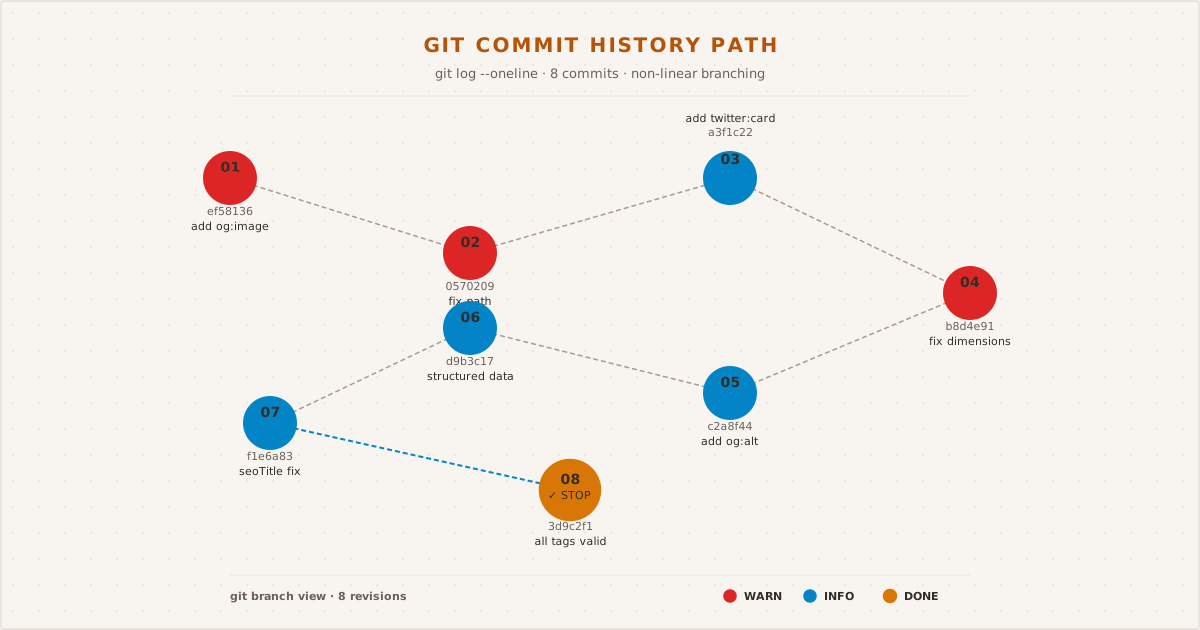
Eight commits, zero straight lines — the meta tag spiral in git form.
I opened Twitter Card Validator expecting a quick check. Instead I got this:
INFO: Page title is okay.
WARN: No twitter:title — falling back to og:title.
WARN: No twitter:description — falling back to og:description.
WARN: No twitter:image — falling back to og:image.
WARN: twitter:image:alt missing — add alt text for accessibility.Five warnings. Zero urgency. I shrugged, added twitter:title, and hit deploy.
Eight commits later I was still tweaking meta tags. Not because the validator kept complaining — it had been silent since round two — but because every “fix” revealed something else that could be better.
This is not a story about meta tags. It is a story about the gap between “working” and “done.”
How It Started#
The setup was simple. An Eleventy blog, static site, no SSR. OG meta tags in base.njk layout. A handful of frontmatter variables — title, description, image — mapped directly to og:title, og:description, og:image. Standard stuff.
The first commit was just a twitter:image:alt using the description field. Four lines in the template. Took thirty seconds. One commit, ef58136. I thought that was it.
It was not it.
The Spiral#
Each round of the spiral followed the same pattern: open validator, notice something suboptimal, fix it, deploy, check the next platform. Lather, rinse, repeat.
Round one: & in preview cards. The title and description frontmatter contained ampersands — “CSS & JavaScript” rendered as CSS & JavaScript in every OG tag. An Eleventy auto-escaping feature that’s correct for HTML but wrong for meta tag content. Fix: | safe filter on every title and description output. Commit 0570209.
Round two: no og:site_name. Facebook card showed the URL, not the site name. Discord card looked anonymous. Fix: add og:site_name to the layout. Commit 6b5031e.
Round three: Twitter-specific tags. Twitter’s documentation says it falls back to OG tags when twitter:* is missing. That fallback works — but relying on it means you have no per-platform control. If Twitter ever changes its fallback logic, your cards break silently. Fix: explicit twitter:title, twitter:description, twitter:image, twitter:site, and twitter:creator. Commit 6aa27ec.
Round four: image dimensions. Without explicit og:image:width and og:image:height, platforms guess the aspect ratio before the image loads. The result can be a layout shift in the card preview or — worse — the favicon being stretched across 1200×630. Fix: conditional width/height tags, only when image is set in frontmatter. Same commit.
Round five: twitter:image:alt for accessibility. Twitter doesn’t display alt text visually, but screen readers use it. Without it, the validator warns. Fix: conditional twitter:image:alt with a dedicated image_alt frontmatter field — not the article description, which serves a different purpose (search snippet). Commit ef58136 (yes, this was actually the first fix — but the spiral wasn’t linear). Later made unconditional with a fallback chain (image_alt → description → metadata.image_alt), so the alt text is never empty even on pages without frontmatter — but that fix came in round eight.
Round six: OG image title text truncated in previews. The homepage OG title was 78 characters. Twitter’s card truncates at ~70. Discord at ~60. The subtitle — “Web Design, Terminal Dev Notes, Open Source Tinkering” — was getting cut mid-word. Fix: shortened the homepage og:title to 44 characters. Commit cfd213c.
Round seven: article metadata. The blog has publish dates and tags. Neither were exposed as structured meta. Every post card was just a generic page — no article:published_time, no article:tag. Fix: conditional article:published_time (only on non-homepage pages with page.date) and a loop over all tags excluding the "posts" collection tag. Same commit as round three.
Round eight: unconditional image metadata. The conditional approach for width, height, and alt had a blindspot — posts without frontmatter image still got og:image via site fallback, but og:image:width, og:image:height, and og:image:alt were silently missing. Twitter fell back to summary card (small icon) instead of summary_large_image. Fix: moved all image metas outside the conditional block, split ogAlt logic — when a page has its own image, alt falls back from image_alt to description; when using the site default image, ogAlt always uses metadata.image_alt (describing the visual, not the page). Set metadata.image_alt as the site-wide default in metadata.js. Now every page — regardless of frontmatter — outputs complete image metadata. Commit 94e39ee.
Eight rounds. Eight commits. Each one individually justified. Collectively: a full afternoon of what felt like productive work that, in retrospect, I could have done in one sitting with the right checklist.
The Research That Should Have Come First#
Somewhere between rounds three and four, I started researching how different platforms consume meta tags. The findings clarified why the spiral happened:
Twitter/X reads twitter:* tags first, falls back to og:* if missing. The fallback is undocumented as a contract — it could change. The explicit approach is defensive.
Discord uses og:, but its image rendering is aggressive — it crops to 16:9 regardless of your ratio, and it pulls the favicon as a fallback if og:image isn’t large enough. Minimum recommendation: 600×315, with 1200×630 as the safe standard.
Facebook respects og:image:width and og:image:height to prevent layout jumps. It also uses og:site_name to display a source label — without it, the card shows the raw domain.
LinkedIn is the most lenient — it reads OG tags correctly but caches aggressively. A stale card can persist for days after a change.
The common thread: none of these platforms validate your tags before rendering. They silently degrade. A broken twitter:image doesn’t give you an error — it shows the favicon stretched to 2:1 ratio and nobody tells you.
That last point is the real danger. If your CSS breaks, the page looks wrong instantly. If your meta tags break, the page looks fine — but every link shared to any platform has a subtly broken preview. You only notice when someone shares your post and the card looks like a ransom note.
The Checklist That Should Have Prevented This#
After the eighth commit, I wrote down exactly what I should have checked before the first deploy. Here it is:
□ og:title exists and is under 60 characters
□ og:title has | safe filter (no &)
□ og:description exists and is under 160 characters
□ og:description has | safe filter
□ og:image exists and is at least 600×315
□ og:image:width and og:image:height present
□ og:url is canonical
□ og:site_name present
□ og:type is "website" (or "article" for posts)
□ twitter:card is "summary_large_image"
□ twitter:title matches og:title (no fallback dependency)
□ twitter:description matches og:description
□ twitter:image matches og:image
□ twitter:image:alt present (use `image_alt` frontmatter, not `description`)
□ twitter:site set
□ twitter:creator set (for author attribution)
□ article:published_time present on posts
□ article:tag present for each relevant tag
□ HTML character entities escaped correctly in all fieldsThat’s nineteen items. Fifteen minutes to audit. It would have saved me the entire afternoon.
What I’d Do Differently#
If I could redo this process, I would not touch base.njk until I had:
- Written the checklist first — not as a theoretical doc, but as a literal TODO list in the editor. Check off each item once, commit once.
- Tested on all platforms before iteration — run the same URL through Twitter Card Validator, Facebook Sharing Debugger, Discord’s embed preview, and LinkedIn Post Inspector in a single batch, not one platform per round.
- Character-counted titles before writing meta — I already had the titles, I just never measured them against platform limits. That should be part of the writing workflow, not the meta debugging workflow.
The Closing#
The final base.njk template has twenty-one property or name attributes across three meta types — OG, Twitter, and Article — plus a fallback chain that ensures every page ships complete image metadata regardless of frontmatter. None of them are clever. Every single one is boilerplate that has been written ten thousand times before by ten thousand other developers.
But they are there. They are consistent. They pass every validator I’ve thrown at them. And the next post I write will deploy with all of them from commit one, because I finally have a checklist that turns a reactive spiral into a fifteen-minute audit.
The hardest part of building this blog was never the CSS, the typography, or the color tokens. It was learning when to stop iterating on things that are already good enough. Meta tags were just the latest reminder.
This post is part of the terminal redesign series. The complete meta template for this blog is open source on GitHub.